Five minutes, 21×, and the job that still hasn't sold
A fast callback is a service standard. The famous multiplier needs a closer reading before it becomes a promise about your sold jobs.
TL;DR
- The five-minute rule's 21× figure concerns qualification in a historical web-lead study. It does not establish a multiplier for HVAC sales.
- Keep the first attempt, successful contact, booking, sale and collection as separate events. An automated receipt can arrive instantly while the customer's request remains unresolved.
- The three source documents reviewed here measure different things. Their numbers cannot be pooled into an average sales lift.
- Use a response-time target as an operating commitment, then check what happens to comparable groups of inquiries. The worksheet below makes the definitions explicit.
Where does the 21× lead-response figure come from?
Part 2 of the 2007 InsideSales.com conference report, checked October 11, 2026, describes three years at six companies, over 15,000 web leads and over 100,000 call attempts. Only leads with an attempted call were included. It reports qualification odds 21 times higher at five minutes than thirty. Qualification varied by company and could include an appointment. That part excludes close ratios; the separate survey in Part 1 discusses them.
The vendor report does not supply the lead-level records and model specification needed to reconstruct this comparison. A large ratio deserves that context when it appears in a software demo or agency proposal.
For a contractor, a booked visit still leaves work to do. The customer may be outside the service area, need a repair the shop does not offer, decline the estimate or cancel. A quick conversation can be useful without guaranteeing a profitable job.
What does an odds multiplier mean?
A probability is the share of events that happen. Odds divide that probability by the probability of the event not happening. They move differently.
Consider a purely mathematical example. Assume an odds ratio of 21 and choose four starting probabilities. These starting values are invented; they are not observations from the study or Lonta customers.
| Assumed starting probability | Probability after multiplying the odds by 21 | Probability ratio |
|---|---|---|
| 2% | 30% | 15× |
| 5% | 52.5% | 10.5× |
| 10% | 70% | 7× |
| 20% | 84% | 4.2× |
The calculation is new probability = 21 × p ÷ (1 − p + 21 × p), where p is the assumed starting probability expressed as a fraction.
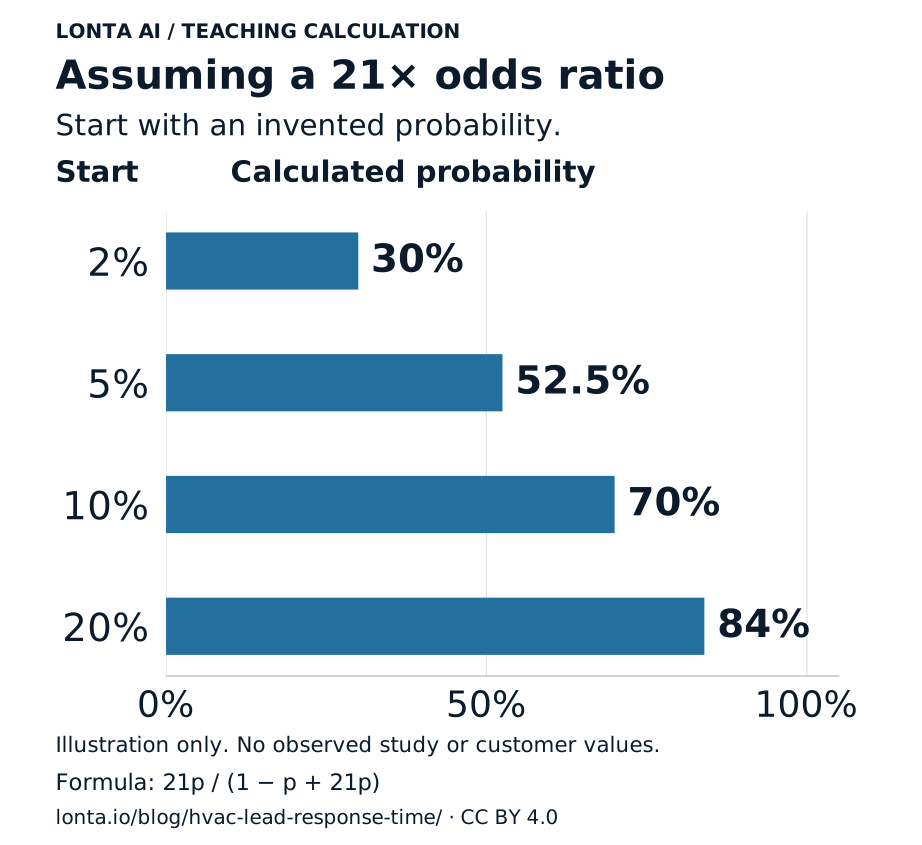
Download the chart as PNG, editable SVG, or the calculation table as CSV.
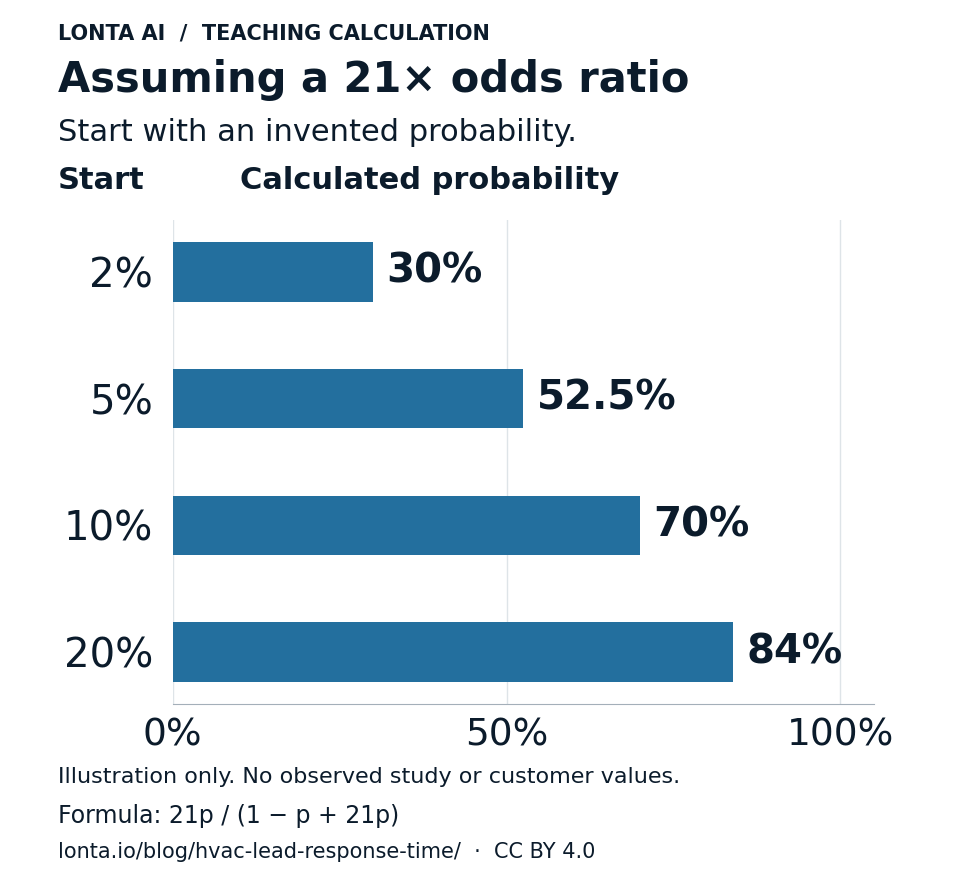
The starting probability changes the result. Even a correctly calculated qualification effect would still require separate evidence before being applied to booked visits, sold replacements or collected revenue.
Does newer home services evidence answer the sales question?
Two newer sources add relevant context, but they do not supply the same experiment.
Invoca's July 2026 home services report reports a 52% person-answer rate for all inbound calls, 65% for calls over fifteen seconds and 73% for calls over thirty seconds. These are different filters on its customer-base data. The home services call count and observation dates are not disclosed; the broader dataset covers more than 70 million calls across ten industries.
Changing the duration filter changes the group being measured. The three rates are not a sequence of improvements caused by a faster callback. An inbound caller waiting on the line also presents a different operating problem from a person who submitted a web form.
Housecall Pro's customer-service survey was conducted on October 23, 2025, with 1,040 US homeowner decision-makers. Its public summary discusses stated preferences about service and speed. That is useful context for the customer experience; it is not a measured response-time effect on completed jobs.
| Source document | What it examines | What an owner still needs |
|---|---|---|
| Historical response study | Web-lead contact and qualification | Evidence about comparable contractor jobs |
| Current call benchmark | Inbound call handling | A consistent call definition and outcome records |
| Homeowner survey | Stated service preferences | Observed behavior and a defined sales outcome |
Download the source register for the links, page or section locators, populations and missing information. This is a targeted review of three public documents, not a systematic search of every response-time study or a statistical meta-analysis. The home services benchmark review covers the broader evidence.
Which response clock should your shop use?
Start with the event the customer experiences. For a web inquiry, record submission, first attempted response and first useful two-way contact. For an inbound call, record whether it was answered and what happened after any missed call. Preserve both channels; a combined average can hide a queue that nobody owns.
An automatic email confirming receipt is an acknowledgment. A dispatcher who confirms the address, job type and available appointment has advanced the request. Record both if both matter. Labeling the acknowledgment as a completed response can make a dashboard look fast while the customer keeps calling competitors.
Keep emergency repair, replacement estimates and maintenance separate. A response target should match the service you promise and the coverage you actually provide. If the office is closed, name the after-hours owner and the next action. A timer without an accountable person will report the delay accurately and leave it unchanged.
How can you check a promise about more sold jobs?
Ask the supplier to name the starting event, response event, outcome and follow-up window. Request the underlying counts beside every percentage. A claim about sales needs sales records; a claim about qualification should retain that label.
Compare inquiries with similar job types, territories and acquisition dates. Follow each group long enough for the relevant jobs to close. Otherwise an older group has more opportunity to sell than a group that arrived yesterday. The booking-rate guide helps keep those denominators consistent.
Record staffing, available appointments, lead source and any other changes made at the same time. A faster team may also have more capacity or receive easier jobs. A simple before-and-after table cannot separate those effects. The agency-report checklist explains what to request when the headline hides the comparison.
Never intentionally delay customers to create a comparison. Existing records can identify gaps; they may be too incomplete to estimate an effect. Write unknown where the outcome is missing. A two-week process check can establish whether the queue is being covered, while replacement sales may need a longer follow-up period.
What this doesn't cover
- A universal five-minute threshold or a causal estimate of additional contractor revenue. None is calculated here.
- A claim that prompt response is unimportant. The review concerns which commercial claim the cited evidence supports.
- A pooled industry effect. The source populations, designs and outcomes differ, and the original lead-level data are unavailable.
- Customer results. The odds table is a teaching calculation with invented inputs; no Lonta client performance is represented.
Do this in your account
- Download the response-time claim worksheet. It is open text with no signup.
- Write separate event definitions for acknowledgment, attempt, contact, booking, sale and collection.
- Assign staffed and after-hours responsibility to the inquiry channels you accept.
- Keep acquisition dates, job types and a stated outcome cutoff beside each comparison. Show the counts, including missing outcomes.
- Review where inquiries stop progressing. Repair that step and document the change before attributing a later sales increase.
More measurement guides are in the sold jobs and CRM hub.
FAQ
Does answering within five minutes guarantee more HVAC sales? No sales guarantee follows from the reviewed documents. Set a service standard that your team can meet, and measure its outcomes with consistent definitions.
Should an automatic text count as a response? Count it as an acknowledgment when it only confirms receipt. Record useful contact or a confirmed booking separately so the customer experience stays visible.
Can I combine phone calls and web forms in one report? Keep a channel breakdown beside the total. Call answer status and elapsed time to a web-form callback describe different events and need different denominators.
Can the three studies be averaged into a sales-lift benchmark? No. A qualification comparison, call-handling rate and preference survey do not measure the same outcome. There is no defensible pooled sales estimate in this review.
Sources
Checked October 11, 2026. The interpretations, odds illustration and worksheet are Lonta's analysis. Drafting and editing used OpenAI Codex. Source publishers sell relevant software; their commercial interests and the limits of their public summaries are retained in the register.
- InsideSales.com / James Oldroyd: Lead Response Management Report, Part 2, pages 20, 21 and 27. Presented October 16, 2007. Part 1 is a separate survey; its sales findings are not the source of 21×.
- Invoca: Home Services Lead Conversion Benchmarks Report 2026, Call Answer Rates and Methodology.
- Housecall Pro: Home Service Customer Service Report, service expectations and Methodology. Survey fieldwork: October 23, 2025.